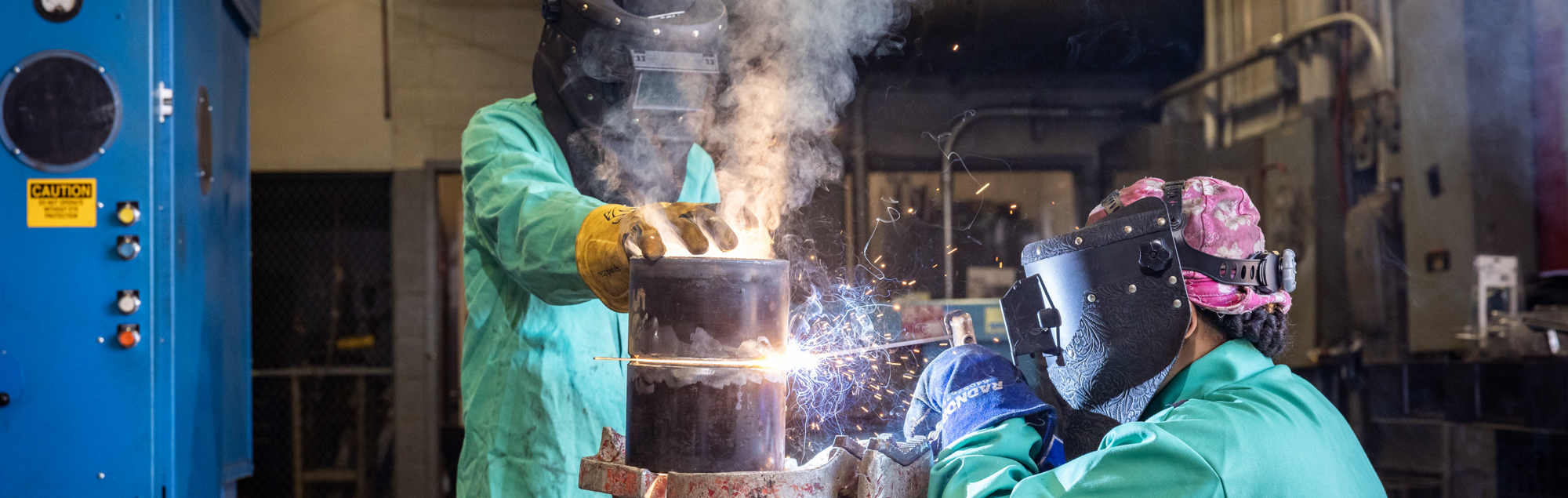
FDTC welding students practice welding in the welding lab

Pipe Welding

Program Type: Certificate in Applied Science

Program Level: UG

Division: Career & Technical Education

Program Duration: 8 months

Program Contact: Willis Ford

Credit Requirement: 23

Time: Day

Program overview

The Pipe Welding program prepares students with the technical skill needed to produce structurally sound, high-quality pipe welds. Instruction emphasizes safety, industry-standard welding processes, and proper pipe layout and fit-up. Graduates are prepared for entry-level employment in maintenance, construction, fabrication, and related fields.

Courses Required

Semester 1

Pipe Fitting & Welding

Course Code: WLD-154

This is a basic course in fitting and welding pipe joints, either ferrous or non-ferrous, using standard processes.


Pipe Welding I

Course Code: WLD-225

This Course Covers the Techniques Used in Shielded Metal Arc Welding of Groove Welds on Pipe.


Inert Gas Welding Pipe I

Course Code: WLD-228

This course covers the techniques used in gas tungsten arc welding of groove welds. on ferrous pipe.


Semester 2

Stainless Steel Pipe Welding

Course Code: WLD-112

This course focuses on the improvement of pipe welding skills and techniques on stainless steel piping according to nuclear weld test standards.


Print Reading And Sketching For Pipe Wld

Course Code: WLD-172

This course introduces the implementation of welding drawings and sketching techniques for pipe welding, to include dimensioning, tolerancing, sectioning, and mating matal parts for pipe welding projects in accordance with technical drawings.


Advanced Pipe Welding

Course Code: WLD-208

This course is a study of advanced pipe welding It also covers the processes to fit and weld ferrous and non ferrous metals.


Entry Requirements

To see a list of entrance requirements for this program, please check the FDTC Academic Catalog.

Academic Catalog

Student Learning Outcomes

Graduates of this program will be able to:

  • Apply industry standard safety practices and specific safety requirements for different welding operations.
  • Calculate necessary measurements to plan for welding sequences.
  • Interpret welding symbols, read, and interpret blueprints and sketches.
  • Demonstrate set-up and operation of welding machines such as SMAW, GTAW, OFW, GMAW, FCAW.