Lacie Cooper, Engineering
Lacie Cooper - Building a Foundation for Success in Manufacturing
For Lacie Cooper, engineering has always been more than solving equations—it's about
understanding how things work and finding better ways to make them work.
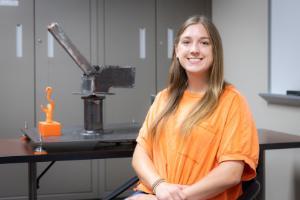
The Georgetown, South Carolina, native graduated from Florence-Darlington Technical
College (FDTC) in May 2026 with an Associate in Applied Science degree in Mechanical
Engineering Technology. Today, she has turned that passion into a career in
manufacturing, where every day presents new opportunities to solve problems, improve
processes, and bring engineering concepts to life.
At FDTC, Lacie developed a strong foundation in mechanical engineering through
courses in 2D and 3D modeling, dynamics, hydraulics, programmable logic controllers
(PLCs), and coding. While each course introduced new technical skills, they also
challenged her to think critically and understand how engineering principles translate
into real-world applications.
One class, in particular, continues to influence her work today.
During her hydraulics course, students used a hydraulic trainer that allowed them to
build and reconfigure different systems while observing how each change affected the
outcome. The hands-on exercises taught her that even small design decisions can
significantly impact performance—an understanding she now applies daily in
manufacturing environments where hydraulic systems are used to lift, lower, push, pull,
and sequence equipment movements.
"The hands-on experience made the concepts click," Lacie said. "Now I see those same
systems in action every day."
Lacie says FDTC's faculty and staff played an important role in helping her reach that
point. Instructors made complex engineering concepts approachable by combining
classroom instruction with practical projects that reinforced what students were
learning. Academic advisors helped her stay on track throughout the program, while
Career Services connected her with employment opportunities that helped launch her
career after graduation.
Although FDTC prepared her well, entering the workforce revealed an important lesson.
"In school, you're usually given all of the information you need to solve the problem," she
explained. "In manufacturing, figuring out where to start is often the hardest part."
She quickly learned that engineers must determine which information matters, account
for unexpected variables, and identify the most effective process before a solution can
even be developed. That experience reinforced the importance of adaptability, critical
thinking, and continuous learning—skills she first began developing at FDTC.